
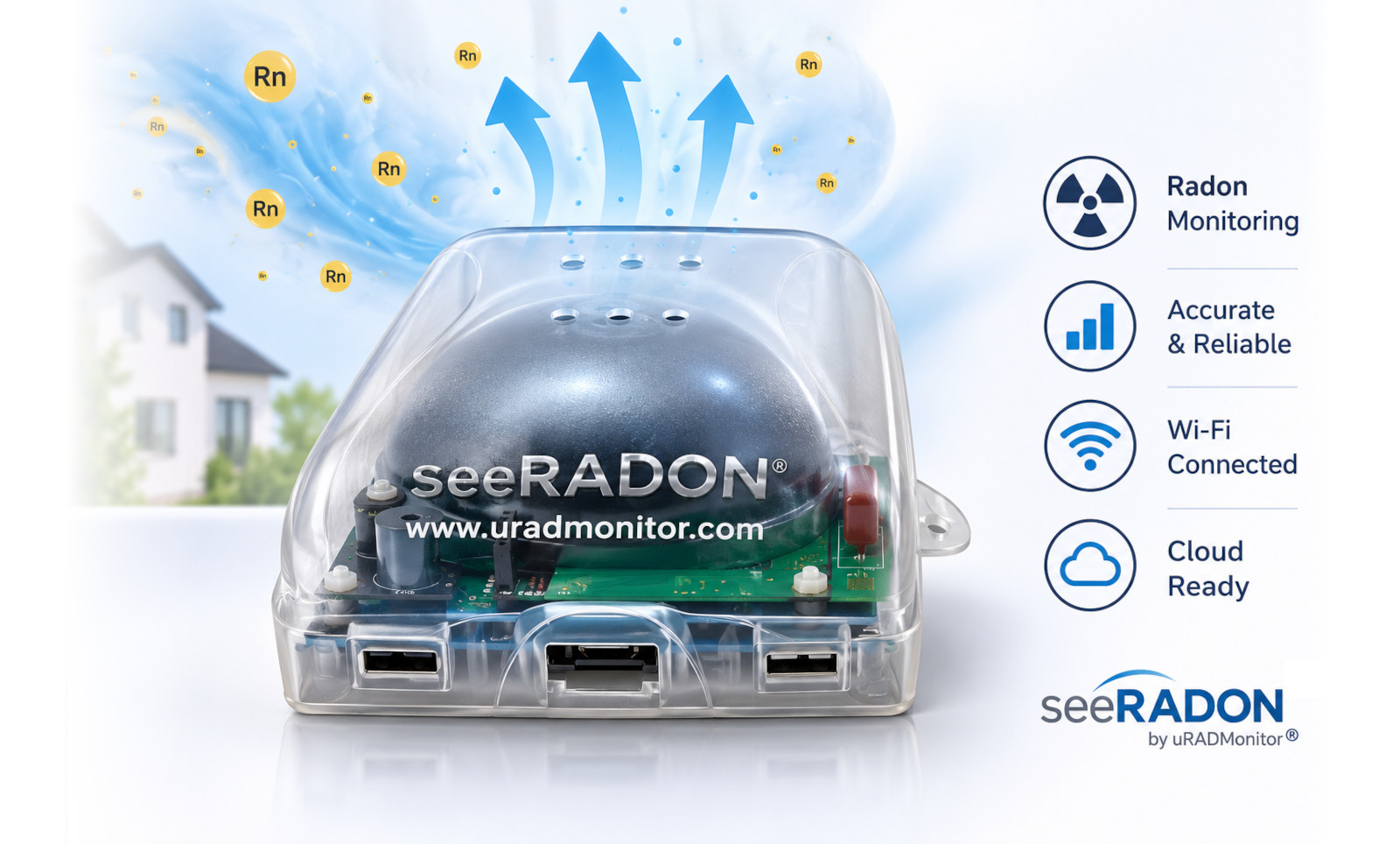
Radon is a colourless, odourless radioactive gas that seeps from the ground into buildings, and it is the second leading cause of lung cancer after smoking. You cannot see, smell or taste it, so the only way to know your exposure is to measure it. A radon detector does that, and a good one does it continuously, so you see how levels change through the day and the seasons rather than relying on a single snapshot. For the health context and safe levels, see radon levels: what is safe at home.
Types of Radon Detector
- Short-term passive kits: charcoal canisters or alpha-track films left in place for a few days to months, then sent to a lab. Cheap and good for a first screening, but slow and a single averaged number.
- Continuous electronic monitors: devices that measure radon in real time and log it, so you see the daily and seasonal pattern and can act immediately. This is what uRADMonitor seeRADON is built for.
Radon is measured in becquerels per cubic metre (Bq/m³). A passive kit gives you one averaged figure; a continuous monitor shows that the same room can swing widely between night and day, or between a sealed winter and a ventilated summer. That pattern is what tells you whether a high reading is a real problem and whether your fix is working.
How Continuous Radon Monitoring Works
Radon decays and emits alpha particles. A continuous radon monitor draws air into a detection chamber and counts those decay events, converting the count into a concentration in Bq/m³ and updating it over time. Because radon fluctuates with ventilation, air pressure and the seasons, a continuous record is far more informative than a one-off test: it shows your real exposure, not a single moment of it.
You are not limited to a single device, either. If you already own a third-party radon monitor such as a GQ RadonPro, AirGradient or Ecowitt unit, you can bring its readings onto the uRADMonitor network through Home Assistant, so your radon data lives alongside everything else you track.
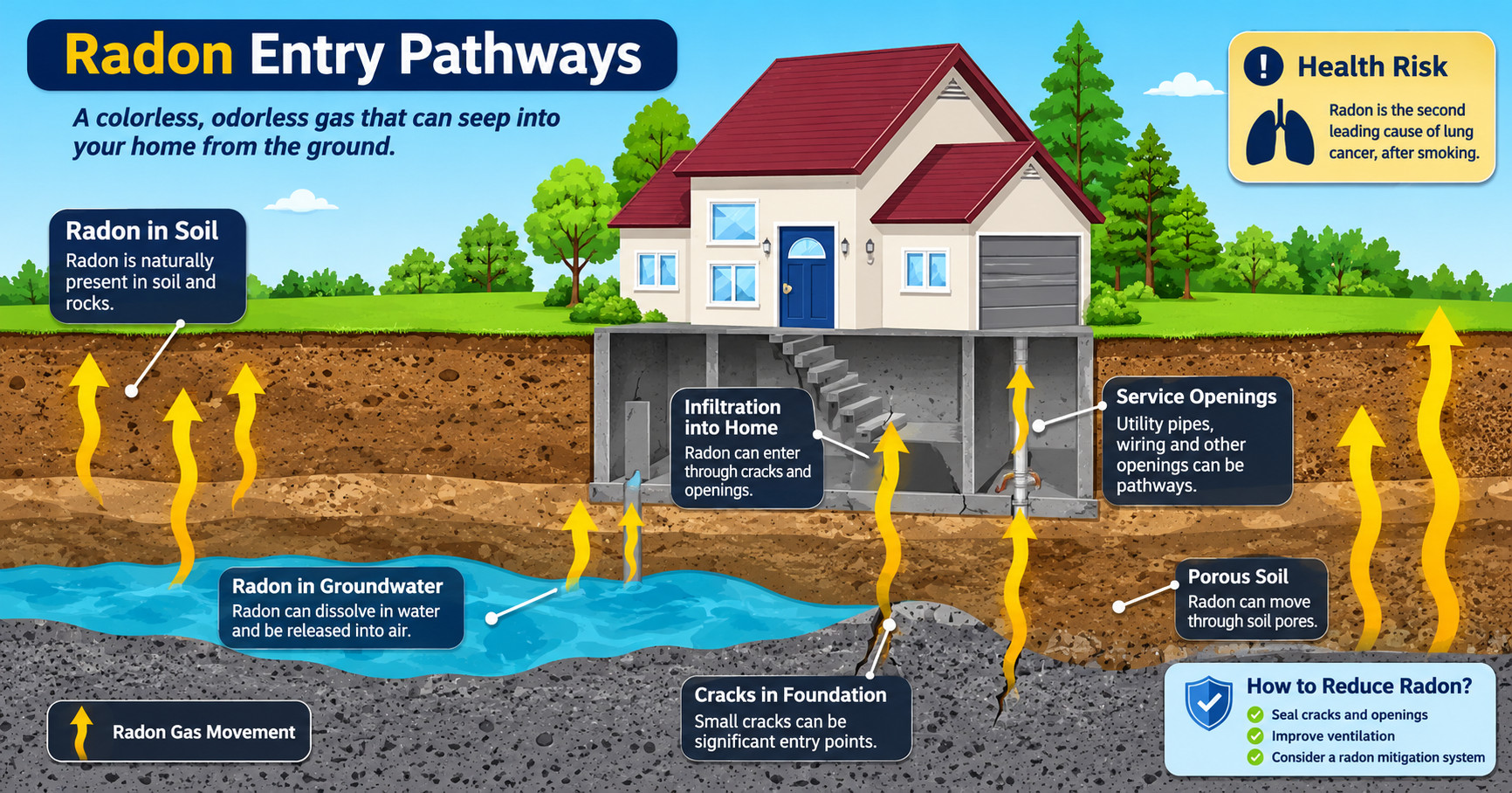
Where to Place a Radon Detector
- Measure in the lowest occupied level of the home, where radon concentrates, typically a basement or ground-floor room that people actually use.
- Place the detector at breathing height, away from draughts, exterior doors and windows, and not right next to a wall or on the floor.
- Measure for long enough to capture the pattern. Radon is lowest when a home is ventilated and highest when it is sealed, so a few days of continuous data beats a single hour.
How to Read the Results
The WHO recommends a reference level of 100 Bq/m³ and advises action well before 300 Bq/m³; the European Union sets a reference level of 300 Bq/m³. If your continuous average sits above these, the usual fixes are improving ventilation, sealing cracks and entry points in floors and foundations, and in higher cases installing a sub-slab depressurisation system. After any fix, keep measuring: continuous monitoring is how you confirm the level has actually dropped and stays down. Radon is one part of the wider picture of indoor air pollution, and it is a form of natural background radiation that happens to concentrate indoors.
Radon Detectors: Frequently Asked Questions
Do I really need a radon detector?
If you spend time on a ground floor or basement, yes. Radon risk depends on local geology and building, and it is invisible, so measuring is the only way to know. It is the second leading cause of lung cancer after smoking.
What is the difference between a radon test kit and a radon monitor?
A test kit is passive: it sits for days or months and gives one lab-analysed average. A continuous monitor measures in real time and logs the data, so you see fluctuations and can confirm whether a fix worked.
What radon level is dangerous?
The WHO reference level is 100 Bq/m³, with action advised below 300 Bq/m³; the EU reference level is 300 Bq/m³. Risk rises with both concentration and years of exposure, so lower and sooner is better.
Can one device measure radon and other air pollutants?
Radon needs a dedicated detector because it is measured differently from particles and gases. A home that wants full coverage typically pairs a radon monitor such as seeRADON with a multi-parameter air quality monitor for PM2.5, CO₂ and VOCs. Our guide on how to choose an air quality monitor covers what to look for.
Liked this? Get monthly air quality findings.
One email a month from the uRADMonitor network. Unsubscribe anytime.
codemore code
~~~~