A Geiger counter, also called a GM counter, is an instrument that detects ionising radiation: the alpha, beta and gamma particles released by radioactive material. It turns each particle it catches into a click or a count, so you can tell whether radiation levels around you are normal or elevated.
This guide explains how a Geiger counter works, what its readings actually mean, the difference between a handheld counter and a connected radiation monitor, and how to choose one.
How does a Geiger counter work?
At the heart of every Geiger counter is a Geiger-Müller tube (a “GM tube”). It is a sealed tube filled with a low-pressure gas, with a high voltage across it. When a particle of ionising radiation passes through, it ionises the gas, triggering a brief avalanche of electrical current. That pulse is one “count”.
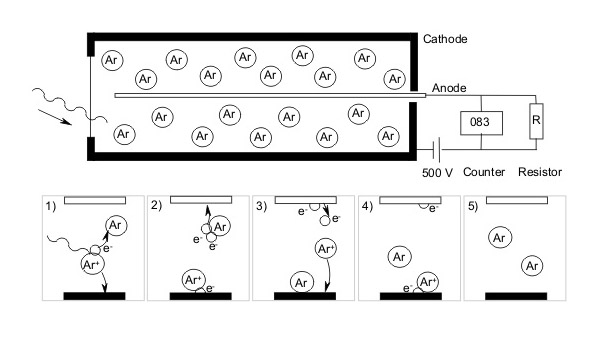
The electronics count these pulses over time. More radiation means more pulses per second. That is the entire principle: a GM tube does not identify which isotope is present, it simply tells you how much ionising radiation is passing through it.
Different GM tubes are sensitive to different types of radiation. Most general-purpose tubes detect beta and gamma; specialised tubes with a thin mica window can also detect alpha particles.
What do the readings mean? CPM and µSv/h
Geiger counters report radiation in two main units:
- CPM (counts per minute): the raw number of radiation pulses the tube registers each minute. It is the direct, honest output of the instrument, but it depends on the specific tube, so CPM from two different devices is not directly comparable.
- µSv/h (microsieverts per hour): an estimate of the dose rate, meaning the biological effect of that radiation on the human body. This is converted from CPM using a calibration factor specific to the tube and is what lets you judge whether a level is safe.
As a rough reference, natural background radiation is typically in the range of about 0.05 to 0.30 µSv/h depending on location, altitude and local geology. A reading that sits far above the local background, sustained over time, is what signals something unusual, not a single brief spike.
Geiger counter vs connected radiation monitor
A classic handheld Geiger counter shows a number on its own screen and nothing more. A connected radiation monitor does the same measurement but also:
- logs the data continuously, so you see trends rather than a single moment;
- sends readings to a dashboard or public map over WiFi, cellular or LoRaWAN;
- lets many devices form a network, so a region is covered rather than a single point.
For anyone who wants early warning, long-term records, or to contribute to a shared picture of environmental radiation, a connected monitor is far more useful than a standalone counter. A single handheld device tells you about one spot right now; a network tells you how radiation is behaving across a city or a country over time.
How to choose a radiation detector
- What radiation you need to detect. Beta and gamma cover most environmental monitoring. Add an alpha-capable tube only if you need to check surfaces or specific materials.
- Calibration. A reading in µSv/h is only as trustworthy as the calibration behind it. Look for documented calibration.
- Logging and connectivity. If you want more than a momentary reading, choose a device that records and transmits data.
- Continuous vs spot use. For fixed, always-on monitoring of a location, a mains or solar-powered connected monitor beats a battery handheld.
- A network to join. A detector that plugs into an existing open network gives your readings context, because you can compare against hundreds of other stations.
uRADMonitor radiation detectors
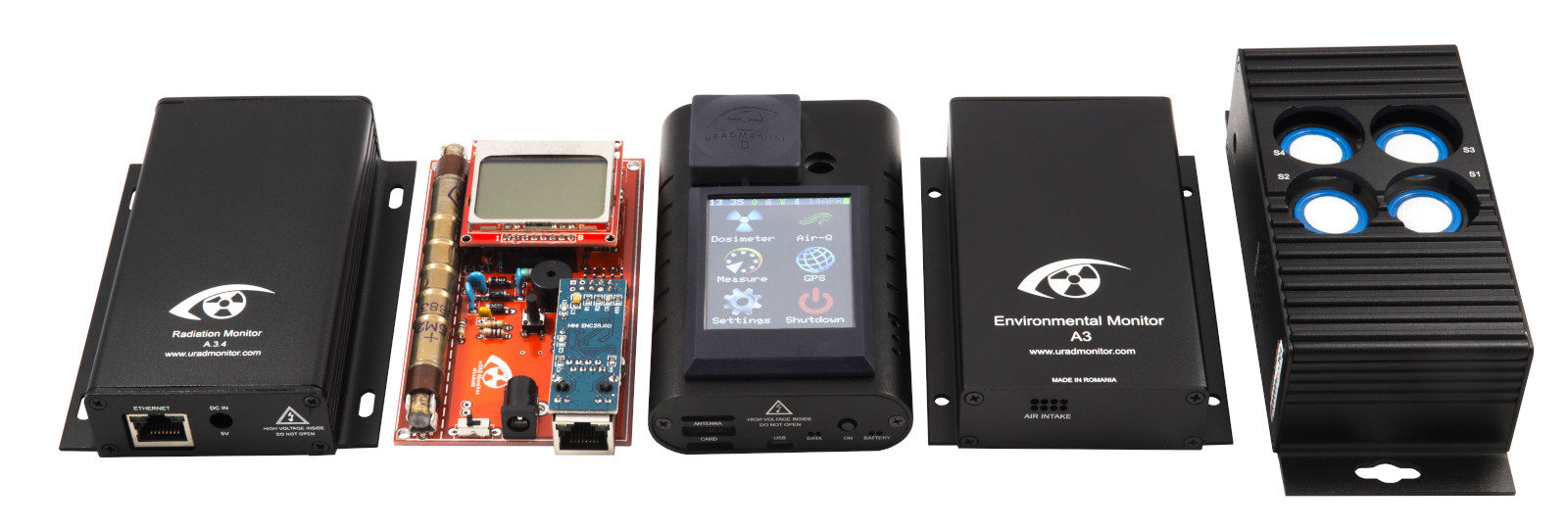
uRADMonitor began as a radiation monitoring network and radiation remains its core strength. Every uRADMonitor radiation device uses a Geiger-Müller tube and reports to the same global, real-time, open map, so a reading in one city sits alongside readings from around the world.
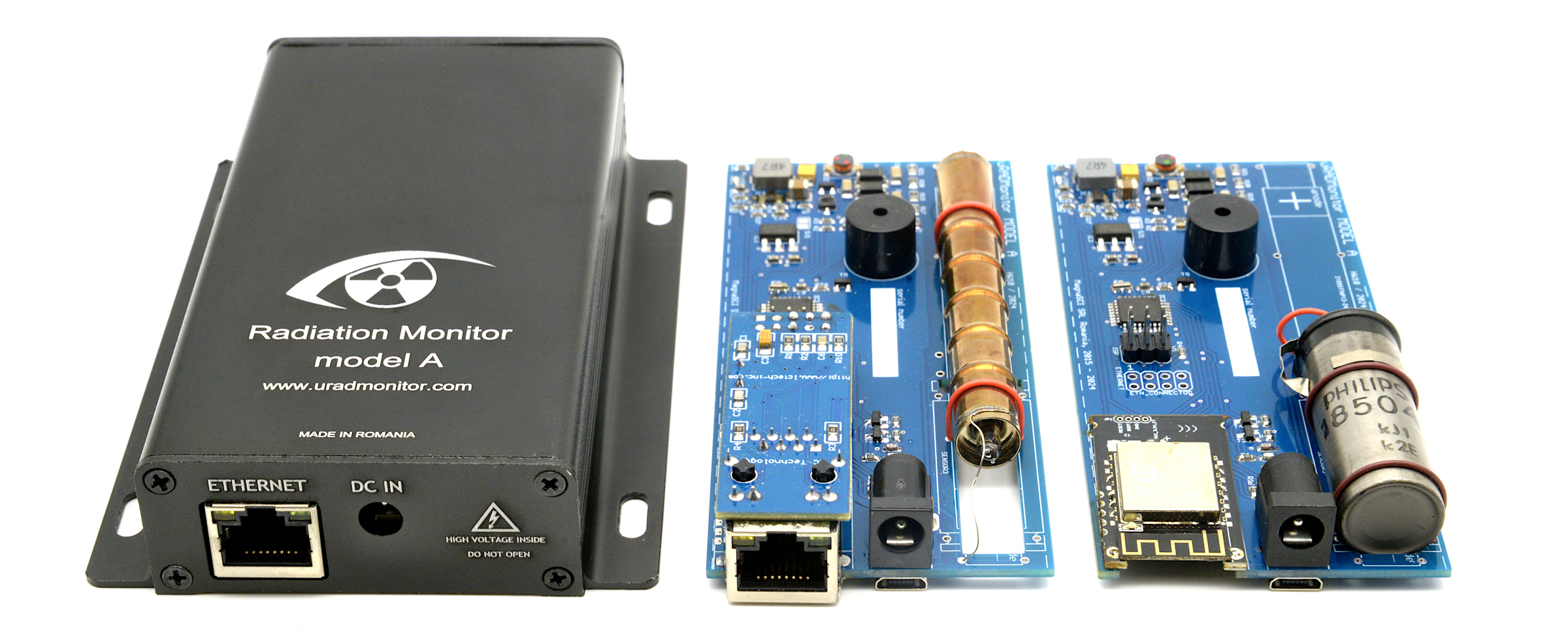
The KIT1 is a build-it-yourself connected Geiger counter for enthusiasts and educators who want a dosimeter that logs to the network over Ethernet. For fixed, autonomous monitoring, the MODEL A is a self-contained radiation station. All of them feed the public radiation map, where levels are shown in real time.
Read more about the Geiger tubes uRADMonitor uses, see how CPM converts to µSv, or browse the full range on the products page.
Frequently asked questions
What is CPM in radiation? CPM means counts per minute, the number of radiation pulses a Geiger-Müller tube detects each minute. It is the raw reading of the instrument before conversion to a dose rate in µSv/h.
Can a Geiger counter detect uranium? Yes. A Geiger counter with a suitable tube detects the radiation emitted by uranium and other radioactive materials. A tube with an alpha-capable window is better for checking surfaces directly.
What is a safe radiation level? Natural background radiation of roughly 0.05 to 0.30 µSv/h is normal. Concern comes from levels sustained well above the local background. A single brief spike is usually not meaningful.
What is the difference between a Geiger counter and a dosimeter? A Geiger counter measures the radiation rate at a moment. A dosimeter accumulates total exposure over time. Many connected monitors do both by logging the rate continuously.
Liked this? Get monthly air quality findings.
One email a month from the uRADMonitor network. Unsubscribe anytime.

codemore code
~~~~