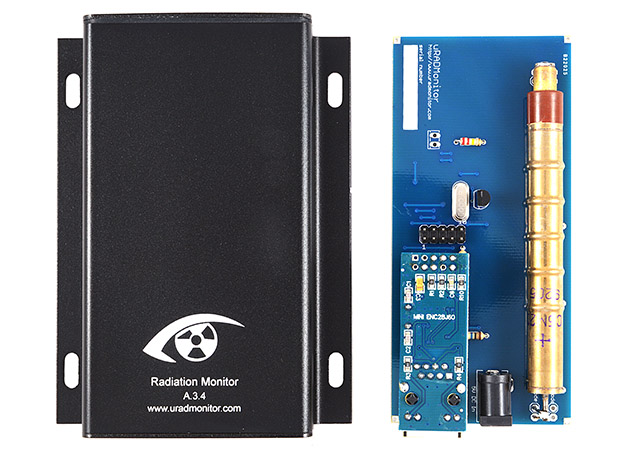
uRADMonitor model A uses the military grade SBM20 Geiger Tube to detect gamma and x-ray ionising radiation. It also features a digital temperature sensor.
| Sensor | Parameter | Minimum value | Maximum value |
| Dallas DS18B20 | Temperature | -55 °C | +125 °C |
| SBM20 * | γ,x-rays | 0.01μSv/h | 9999.99μSv/h |
* Each Model A dosimeter is subjected to a final test: the tested device must be in a confidence interval of 5% in comparison to a master. This master is adjusted to a gauged reference Cs-137 emitter.
The purpose of the Model A is to generate a global image on the radioactive background level, ranging from natural sources such as soils rich in radioactive elements to man made sources mostly released in case of nuclear incidents, illegal nuclear activities or illegal transportation of nuclear materials. Being spread across the entire planet, the network of Model A detectors provides early warning and action can be taken to limit further damage.
Ionizing radiation is harmful to living organisms because it can cause damage to cells that can result in multiple disorders , the most common of which is cancer. Ionizing radiation is naturally occurring from cosmic and terrestrial sources, but there are also artificial generators related to nuclear activities or x-ray devices . Worldwide global average dose is 3.01mSv [1].
[1]
Radiation Health Effects, US Environmental Protection Agency
The model A is designed as a fixed monitoring station. Monitoring radiation brings certain advantages over simply using a handheld unit occasionally. First it's the capability of identifying the radiation trend, due to long term measurements, and taking action in regards to the evolution of numbers rather than not knowing how to interpret short time readings. Then with long term continuous monitoring we get a clue even on low level changes that often evade portable localized readings (unless the levels are higher). Finally having an automated system monitoring radiation 24/7 results in keeping you informed all the time, not only on occasional situations like when using a handheld for an isolated check. The data can be viewed remotely
on a computer or
on a mobile device. You can also access the unit in your LAN directly, by opening its DHCP assigned IP in your Internet browser.
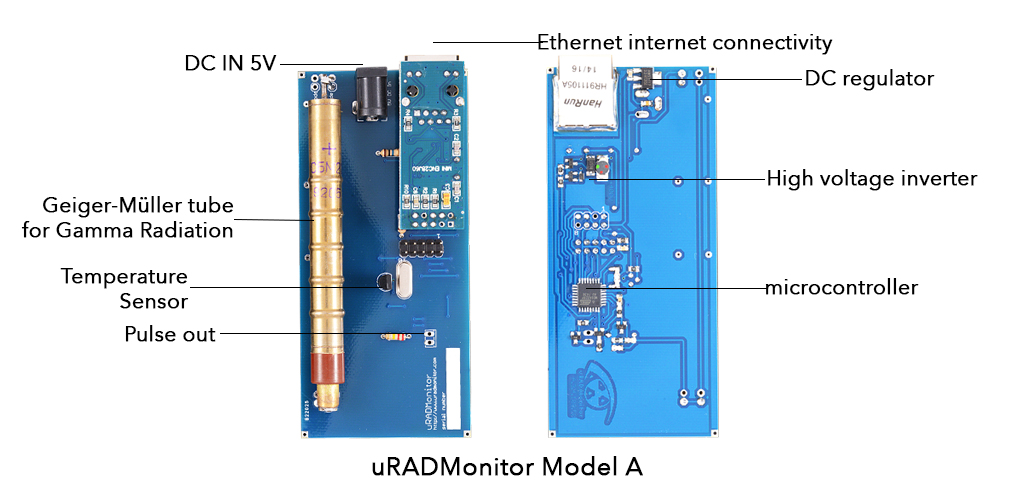
| Item | Parameter | Ratings |
| Voltage | External | 5V - 9V |
| Connectivity | Ethernet | |
| Microcontroller | Atmega328p | 8 bit |
| Enclosure | Rugged aluminium | 110x80x24 mm |
| Temperature | Operating Range | -20°C to +65°C |
Your uRADMonitor should be mounted outside, but not directly exposed to sun, to avoid overheating in warmer areas. A covered spot with some shadow in the free air is ideal. The unit has a rugged aluminium enclosure that is rainproof when mounted with the cables down. The enclosure has wall-mounting brackets, making installation easy. A distance of 1 meter (3 feet) above the ground level is recommended for more relevant measurements.
Connect the uRADMonitor to the power source using the DC cable and the power adapter, and to the Internet router using the Ethernet cable. Use a longer cable if needed. The Internet router must have DHCP enabled. When powered, the uRADMonitor gets an IP automatically, via DHCP, and will show up on the map. It uses very little energy to run!