uRADMonitor model INDUSTRIAL uses a high quality laser scattering sensor to measure Particulate Matter PM1, PM2.5 and PM10 concentrations in air. Four additional electrochemical sensors measure Carbon Monoxide, Sulphur Dioxide, Nitrogen Dioxide and Ozone by default, interchangeable to support additional gases resulting from production or industrial processes. A MOX VOC sensor measures volatile organic compounds. A built in fan assures an active air flow stream across the sensing elements. The MEMs sensor reads ambient temperature and humidity, and a noise sensor measures the noise level. This product is intended for the industrial sector where medium and high gas concentrations need to be observed.
| Sensor | Parameter | Minimum value | Maximum value |
| MEMs | Temperature | -40 °C | +85 °C |
| Humidity | 0% RH | 100% RH |
| Barometric Pressure | 300 hPa | 1100 hPa |
| Laser scattering | PM1.0 | 0 μg/m³ | 1000 μg/m³ |
| PM2.5 | 0 μg/m³ | 1000 μg/m³ |
| PM10 | 0 μg/m³ | 1000 μg/m³ |
| MOX | VOC | 10 ppm | 1000 ppm * |
| Analogue sound sensor | Noise level | 30dB | 130dB |
| Electrochemical | Ozone | 0 ppm | 10 ppm |
| Electrochemical | Nitrogen Dioxide | 0 ppm | 10 ppm |
| Electrochemical | Sulphur Dioxide | 0 ppm | 20 ppm |
| Electrochemical | Carbon Monoxide | 0 ppm | 200 ppm |
By the nature of the technology used, any sensor can potentially fail to meet specification without warning. We make every effort to ensure reliability of all sensors but where life safety is a performance requirement of the product and, where practical, we recommend that all gas sensors and instruments using sensors are checked for response to gas before use.
We accept no liability for any consequential losses, injury or damage resulting from the use of the uRADMonitor products. Customers should test the sensors under their own conditions to ensure that the sensors are suitable for their own requirements and in accordance with the plans and circumstances of the specified project and any standards / regulations pertaining to the country in which the sensors will be utilized.
Custom gases detection options
* The unit comes with Ozone, Nitrogen Dioxide, Sulphur Dioxide and Carbon Monoxide calibrated electrochemical sensors built in. These 4 sensors, can be replaced with any combination of sensors for the below gases and ranges. In some situations we can offer custom detection intervals (eg. 0-1000ppm for CO, etc):
| Symbol | Gas | Detection interval |
| CO | Carbon monoxide | 0 - 200ppm |
| O2 | Oxigen | 0 - 25%VOL |
| NH3 | Ammonia gas | 0 - 100ppm |
| H2S | Hydrogen sulfide | 0 - 100ppm |
| SO2 | Sulfur dioxide | 0 - 20ppm |
| NO2 | Nitrogen dioxide | 0 - 10ppm |
| Cl2 | Chlorine gas | 0 - 20ppm |
| O3 | Ozone | 0 - 10ppm |
| H2 | Hydrogen gas | 0 - 1000ppm |
| HF | Hydrogen fluoride | 0 - 10ppm |
| C2H4 | Ethylene | 0 - 100ppm |
| CH2O | Formaldehyde | 0 - 10ppm |
| ETO | Ethylene oxide | 0 - 20ppm |
| HCl | Hydrogen chloride | 0 - 20ppm |
| C6H6 | Benzene | 0 - 100ppm |
| C7H8 | Toluene | 0 - 500ppm |
| C2H3Cl | Vinyl chloride | 0 - 20ppm |
| C2H6S | Methyl Sulfide | 0 - 100ppm |
| C2H6S2 | Dimethyl Disulfide | 0 - 100ppm |
| AsH3 | Arsine | 0 - 3ppm |
| C3H9N | Trimethylamine | 0 - 100ppm |
| C8H8 | Styrene | 0 - 100ppm |
| CH4S | Methanethiol | 0 - 100ppm |
| CS2 | Carbon Disulfide | 0 - 100ppm |
| PH3 | Phosphine | 0 - 10ppm |
| HCN | Hydrogen cyanide | 0 - 100ppm |
Notes:
Only sensors marked in green are currently available.
All sensors are individually tested and calibrated.
Air pollution is the single largest environmental cause of premature death in urban Europe and transport is the main source. The 2008 Air Quality Directive, now under review, obliges member states to cut exposure to fine particulate matter by an average of 20% by 2020, based on 2010 levels.
The National Emissions Ceiling Directive caps some emissions including particulate matter (PM) and nitrogen dioxide (NOx) at national level. A revised version of the directive is as of 2016 under scrutiny by the Council of Ministers and European Parliament. Across the EU in 2013, nitrogen dioxide (NO2), which is mostly produced by traffic, caused 68,000 premature deaths. The Dieselgate scandal exposed how Volkswagen had gamed NO2 emissions tests.
Ozone (O3) killed 16,000 and small particulate matter (PM2.5) caused 436,000 deaths in the same year. PM2.5 particles, microscopic specks of dust and soot caused by burning fossil fuels, can enter the lungs and bloodstream.
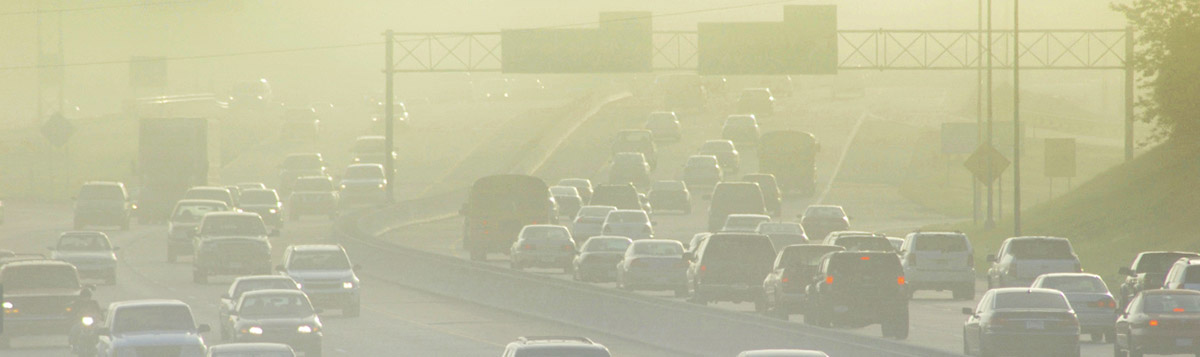
Air pollution has different particulate matter (PM) components – smoke, dirt and dust form coarse particles known as PM10 and metals and toxic exhaust from smelting, vehicle exhaust, power plants and refuse burning forming fine particles called PM2.5.
uRADMonitor INDUSTRIAL is intended for the industrial sector where medium and high gas concentrations need to be observed.
The model INDUSTRIAL is designed as a fixed monitoring station. It comes in 2 variants, with the same sensors but offering different connectivity options: Wifi and LoraWAN. It takes any voltage in the 6V - 24V interval and uses less than 1 Watt of power to run. It can be powered using a small solar panel making it the perfect remote surveillance monitor. This unit doesn't have a screen, it works as a monitor and the data can be viewed remotely
on a computer or
on a mobile device.
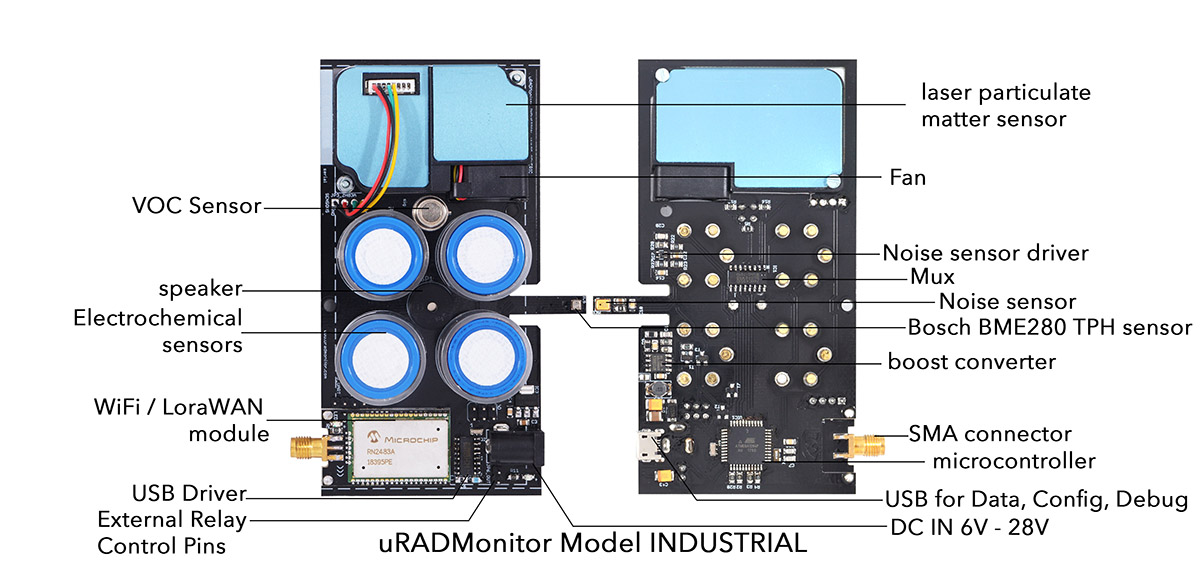 Picture: uRADMonitor INDUSTRIAL motherboard front and bottom view
| Item | Parameter | Ratings |
| Voltage | External | 6V - 24V |
| Connectivity | 4 options | WiFi, LoRaWAN, USB |
| Microcontroller | Atmega1284p | 8 bit |
Your uRADMonitor unit can be mounted both indoors and outdoors, but not directly exposed to sun, to avoid overheating in warmer areas. A covered spot with some shadow if installed in the free air, is ideal. The unit has a rugged aluminium enclosure that is not rainproof due to the air vents. Make sure that nothing is blocking the air vents. The enclosure has wall-mounting brackets, making installation easy.
If you have a radio variant with an antenna, connect the antenna first. Next, connect the uRADMonitor to the power source using a DC adapter with voltage between 6V and 24V. Connect the uRADMonitor to the power source using a DC adapter with voltage between 6V and 24V or via the USB port with a 5V USB adapter.
The WIFI variant
Use a smartphone or a computer with WLAN capabilities to connect to the local hotspot spawned by your unit. The SSID is uRADMonitor-XX, where XX are the last two digits of the Device ID number. The key is the Device ID, in uppercase, as printed on the enclosure. Open 192.168.4.1 in your browser, and click the "WIFI" link to setup the connection to the Internet AP. Enter the SSID and key of your Internet Access Point. If the connection fails, you will see the status message, and three consecutive beeps will indicated the problem. Alternatively you can change the configuration using the USB data port. See the
USB manual.
The LORAWAN variant
Your device must be pre-provisioned with the LoraWAN Gateway and network server details. Alternativelly you can change the configuration using the USB data port. See the
USB manual.
The device comes with an USB port, so the configuration settings can be customized via the USB connection. Consult your product manual for complete details.
 Air pollution has different particulate matter (PM) components – smoke, dirt and dust form coarse particles known as PM10 and metals and toxic exhaust from smelting, vehicle exhaust, power plants and refuse burning forming fine particles called PM2.5.