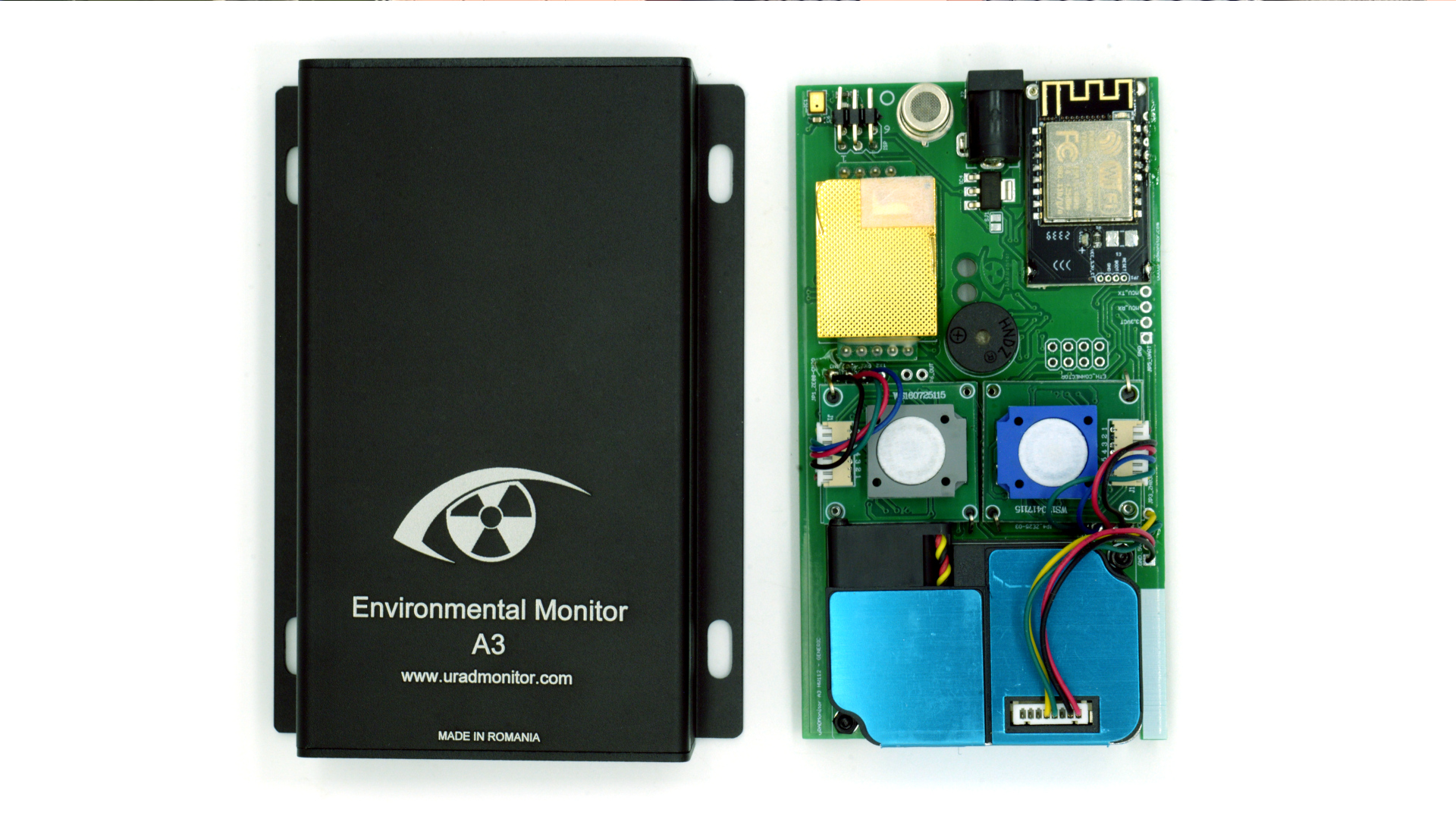
uRADMonitor model A3 uses a MEMs sensor to measure air temperature, humidity and barometric pressure. A MOX VOC sensor measures
volatile organic compounds. A high quality laser scattering sensor is used to detect the
Particulate Matter PM2.5 concentration in air. There are two electrochemical sensors, one for
formaldehyde sensor and another one for ozone and a nondispersive infrared sensor for CO2. A built in fan assures an active air flow stream across the sensing elements. There is also a noise level sensor.
| Sensor | Parameter | Minimum value | Maximum value |
| MEMs | Temperature | -40 °C | +85 °C |
| Humidity | 0% RH | 100% RH |
| Pressure | 300 hPa | 1100 hPa |
| Laser scattering | PM1.0 | 0 μg/m³ | 1000 μg/m³ |
| PM2.5 | 0 μg/m³ | 1000 μg/m³ |
| PM10 | 0 μg/m³ | 1000 μg/m³ |
| Electrochemical | Formaldehyde | 0 ppm | 5 ppm |
| Electrochemical | Ozone | 0 ppm | 10 ppm |
| NDIR | Carbon Dioxide | 400 ppm | 5000 ppm |
| MOX | VOC | 10 ppm | 1000 ppm * |
| Analogue sound sensor | Noise level | 30dB | 130dB |
* VOC concentration interval is estimated for alcohol.
To see complete specs see the technical datasheet.
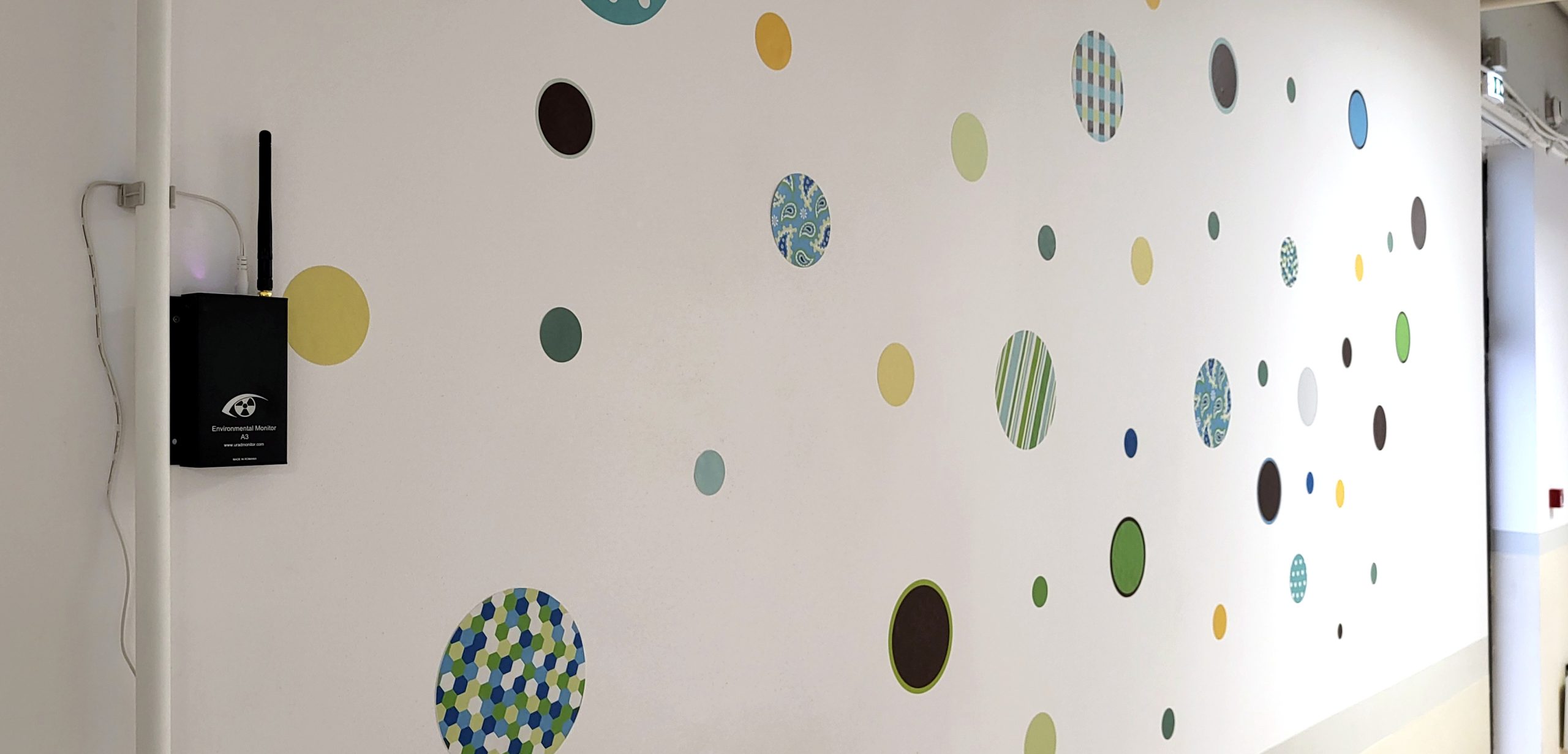
uRADMonitor MODEL A3 in Dumbravita School, Timis
MODEL A3 is a complete air quality station for the classroom and the schoolyard. It measures particulate matter, CO₂, ozone, formaldehyde, volatile organic compounds and noise. Indoors, it shows when a classroom needs fresh air and whether furniture, paint or cleaning products are releasing pollutants. Outdoors, it measures the air around the school, so indoor readings can be compared with outside conditions. It connects over GSM with data included for 10 years, so it does not depend on the school WiFi. It covers the sensor network required for green school status.
Resources:Configurations and quotes:
greenschools.uradmonitor.com.
Technical datasheet with tender compliance table:
PDF.
RO: MODEL A3 este o stație completă de monitorizare a aerului pentru sala de clasă și pentru curtea școlii. Măsoară particulele în suspensie, CO₂, ozonul, formaldehida, compușii organici volatili și zgomotul. În interior, arată când clasa trebuie aerisită și dacă mobilierul, vopselele sau produsele de curățenie degajă poluanți. În exterior, măsoară aerul din jurul școlii, astfel încât valorile din clase pot fi comparate cu cele de afară. Se conectează prin GSM, cu date incluse pentru 10 ani, deci nu depinde de WiFi-ul școlii. Acoperă rețeaua de senzori cerută pentru statutul de școală verde.
Resurse:Configurații și oferte:
scoliverzi.uradmonitor.com.
Fișa tehnică F5 cu tabelul de corespondență:
PDF.
 uRADMonitor sensors in Bistrita, Romania
EN: MODEL A3 is compact, low-power and affordable enough for dense networks. Dozens of stations across neighbourhoods, schools, parks and public transport show how pollution and noise change from street to street and hour to hour. That level of detail is impossible with a few reference stations. All data is public in real time and available through an API for municipal dashboards, citizen apps and research.
RO: MODEL A3 este compact, cu consum redus și un cost care permite rețele dense. Zeci de stații în cartiere, școli, parcuri și transport public arată cum variază poluarea și zgomotul de la o stradă la alta și de la o oră la alta. Acest nivel de detaliu nu se poate obține cu câteva stații de referință. Toate datele sunt publice în timp real și disponibile prin API pentru dashboarduri municipale, aplicații pentru cetățeni și cercetare.
Many of the pollutants measured by Model A3 can have a negative impact on our health, ranging from simple allergies to various cancers. Therefore the data gathered by this device is valuable for our understanding on the quality of our
environment.
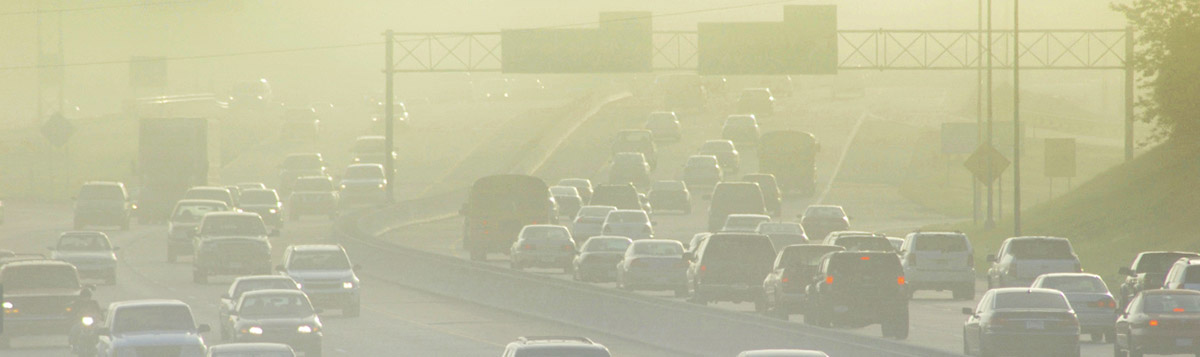 Picture: uRADMonitor fights pollution to improve our health
VOC or volatile organic compounds
are a class of substances that evaporate at room temperature. Being different
substances may be responsible for a broad category of disorders, including respiratory problems, allergic or weakening
immunity in children. Some VOC ‘s are responsible for the formation of smog, irritation of eyes, nose and throat,
headaches and concentration problems. In extreme circumstances, more severe complications can occur, such as
damage to liver, kidney and central nervous system or cancer [1]
Particulate matter PM2.5 refers to small particles with a diameter of up to 2.5 microns. These particles can penetrate
deep into the lungs , causing allergies, respiratory and cardiovascular diseases [2]
Formaldehyde is a toxic colorless gas with a pungent smell, that results from the burning of carbon based materials. It
can be found in forest fires, in automobile exhaust and cigarette smoke. It is an allergenic and a known carcinogenic
compound that can cause serious health effects, depending on concentration and exposure. Even in tiny quantities just
above 0.1ppm it can irritate the eyes and nose, and can worsen asthma symptoms [3]
Carbon dioxide is a gas heavier than air. In small quantities of up to 5000ppm (0.5% ) can cause headaches, lethargy,
slowing of intellectual ability, irritability, sleep disturbance. In larger quantities can cause dizziness, loss of sight, hearing
or knowledge. The fresh air contains between 360ppm and 410 ppm of CO2 [4]
Ozone can cause the muscles in the airways to constrict, trapping air in the alveoli. This leads to wheezing and
shortness of breath. Long-term exposure to ozone is linked to aggravation of asthma, and is likely to be one of many
causes of asthma development. Long-term exposures to higher concentrations of ozone may also be linked to
permanent lung damage, such as abnormal lung development in children. [5]
Noise Induced Hearing Loss (NIHL) is the most common and often discussed health effect, but research has shown
that exposure to constant or high levels of noise can cause countless adverse health affects. [6]
[1]
Volatile Organic Compounds’ Impact on Indoor Air Quality, US Environmental Protection Agency
[2]
Health and Environmental Effects of Particulate Matter (PM), US Environmental Protection Agency
[3]
ToxFAQs™ for Formaldehyde, Agency for Toxic Substances and Disease Registry
[4]
Effects of low-level inhalation exposure to carbon dioxide in indoor environments
[5]
Health Effects of Ozone Pollution, US Environmental Protection Agency
[6]
Noise Pollution, US Environmental Protection Agency
The model A3 is designed as an automated, fixed, Air Quality monitoring station. The A3 is IOT and it comes in 4 variants, with the same sensors but offering different connectivity options: Ethernet, Wifi, GSM/GPRS and LoraWAN. It takes any voltage in the 6V - 28V interval and uses less than 1 Watt of power to run. A built in speaker can provide audible notifications, configurable via
the dashboard. This unit doesn't have a screen, it works as a monitor and the data can be viewed remotely
on a computer or
on a mobile device.
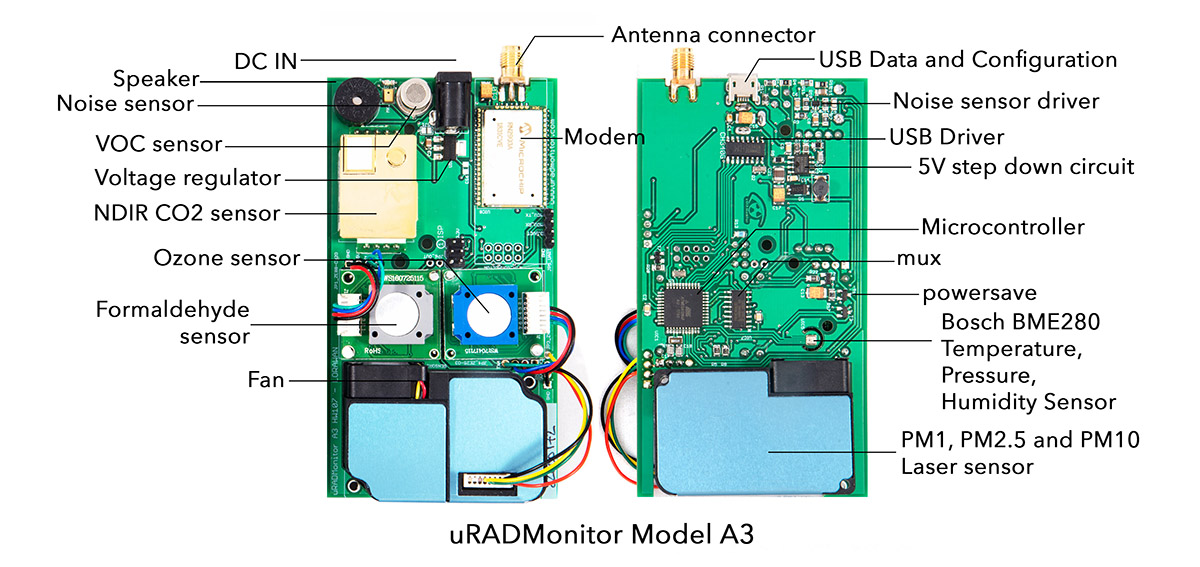 Picture: uRADMonitor A3 motherboard front and bottom view
| Item | Parameter | Ratings |
| Voltage | External | 6V - 28V |
| Connectivity | 4 options | Ethernet, WiFi, GSM, LoRaWAN |
| Microcontroller | Atmega1284p | 8 bit |
| Enclosure | Rugged aluminium | 110x80x24 mm |
 uRADMonitor A3 in aluminium enclosure for indoors vs white stevenson shield for outdoors
Your uRADMonitor unit can be mounted both indoors and outdoors. By default it comes in its default aluminium enclosure, that is not rainproof. For outdoors, use the special
Stevenson Shield designed for the A3 that protects it from excessive sun, rain or snow. Make sure that nothing is blocking the air vents. The enclosure has wall-mounting brackets, making installation easy.
If you have a radio variant with an antenna, connect the antenna first. If it is the wired variant, connect it to the Internet Router using the Ethernet cable. Connect the uRADMonitor to the power source using a DC adapter with voltage between 6V and 28V or via the USB port with a 5V USB adapter.
The Ethernet variant
Make sure the device is connected to the Internet router using the Ethernet cable. Use a longer cable if needed. The Internet router must have DHCP enabled. When powered, the uRADMonitor gets an IP automatically, via DHCP, and will show up on the map automatically.
The WIFI variant
Use a smartphone or a computer with WLAN capabilities to connect to the local hotspot spawned by your A3 unit. The SSID is uRADMonitor-XX, where XX are the last two digits of the Device ID number. The key is the Device ID, in uppercase, as printed on the enclosure. Open 192.168.4.1 in your browser, and click the "WIFI" link to setup the connection to the Internet AP. Enter the SSID and key of your Internet Access Point. If the connection fails, you will see the status message, and three consecutive beeps will indicated the problem. Alternatively you can change the configuration using the USB data port. See the
USB manual.
The LORAWAN variant
Your device must be pre-provisioned with the LoraWAN Gateway and network server details. Alternativelly you can change the configuration using the USB data port. See the
USB manual.
The GSM variant
A data SIM card must be inserted in your A3 unit before it can connect over Internet.
Starting with hardware version HW106, the LoRaWAN, Wifi and GSM settings can be customized via the USB connection. Consult your product manual for complete details.