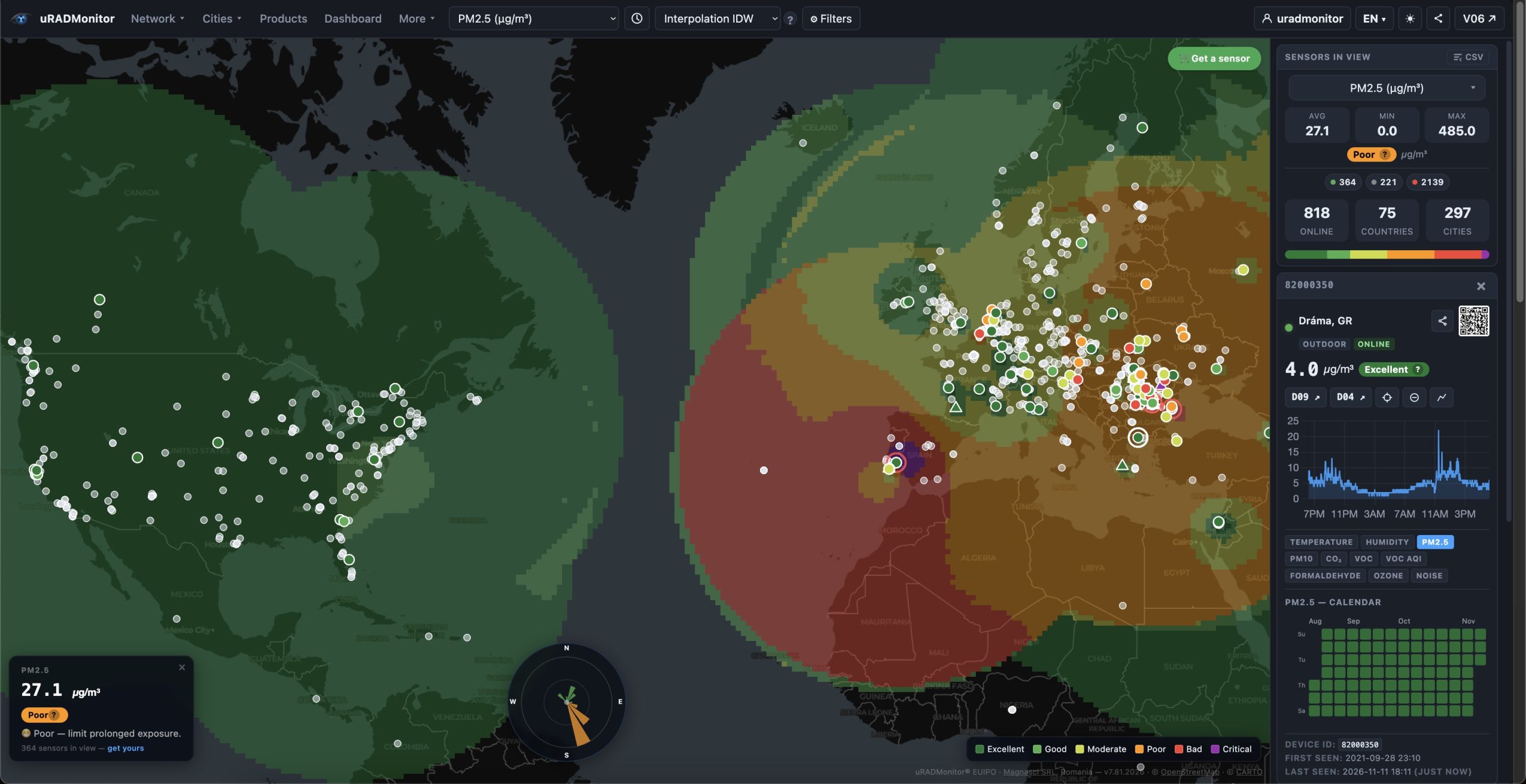
uRADMonitor now ingests RNMCA, Romania’s national air-quality network, as a native data source: its roughly 188 government reference stations appear on the live map and in the API alongside the low-cost sensor network. It is the first government reference network folded into the infrastructure, and others will follow.
A first for the network
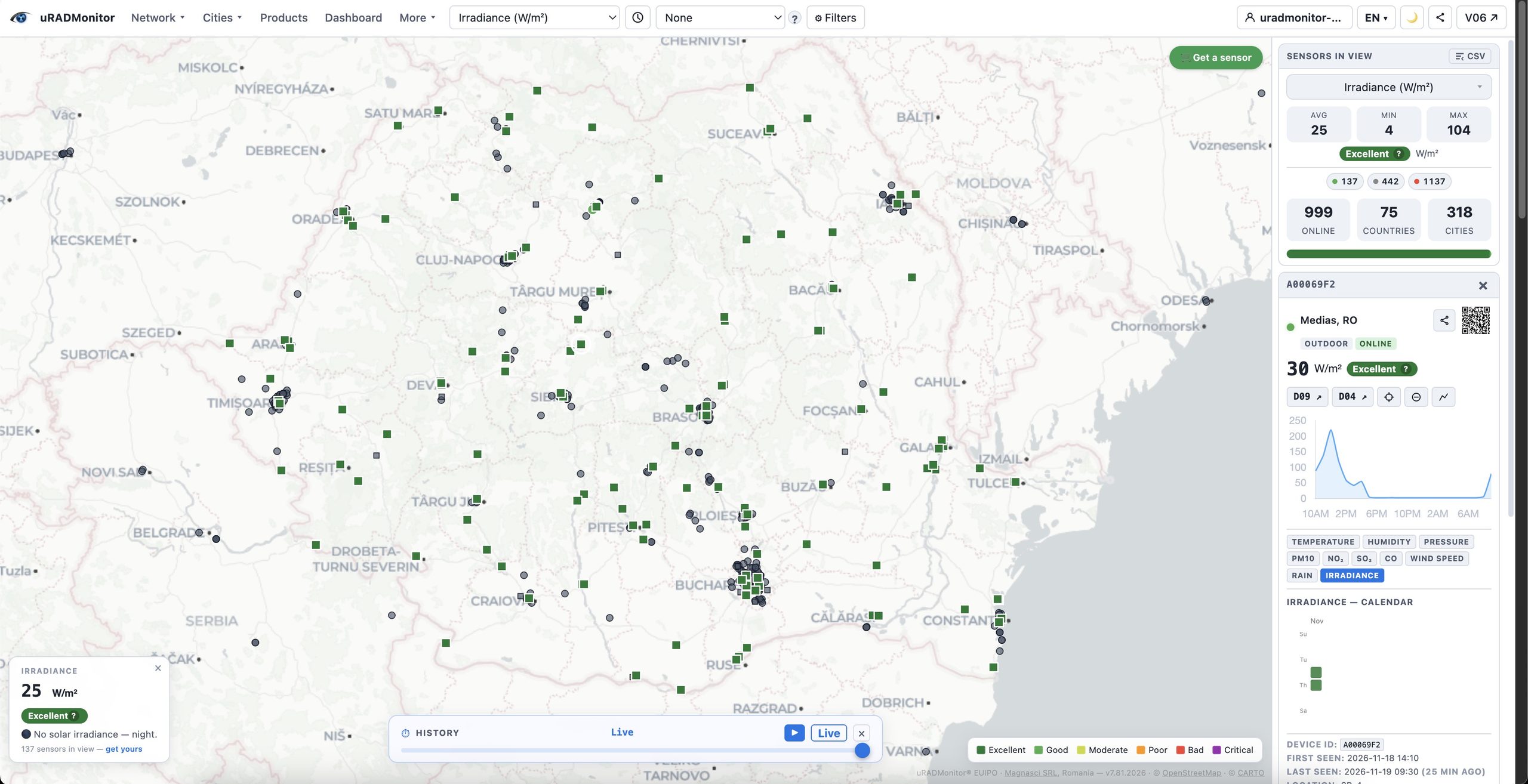
RNMCA, ( Rețeaua Națională de Monitorizare a Calității Aerului), is Romania’s official air-quality network, run under the National Environmental Protection Agency (ANPM), with regulatory-grade analysers at fixed reference stations. uRADMonitor now polls it continuously and stores every station as a native device, so the public map and the API carry official reference data next to the community’s low-cost sensors for the first time. RNMCA is the first such network integrated; the architecture is built to take others, country by country.
Higher resolution, together
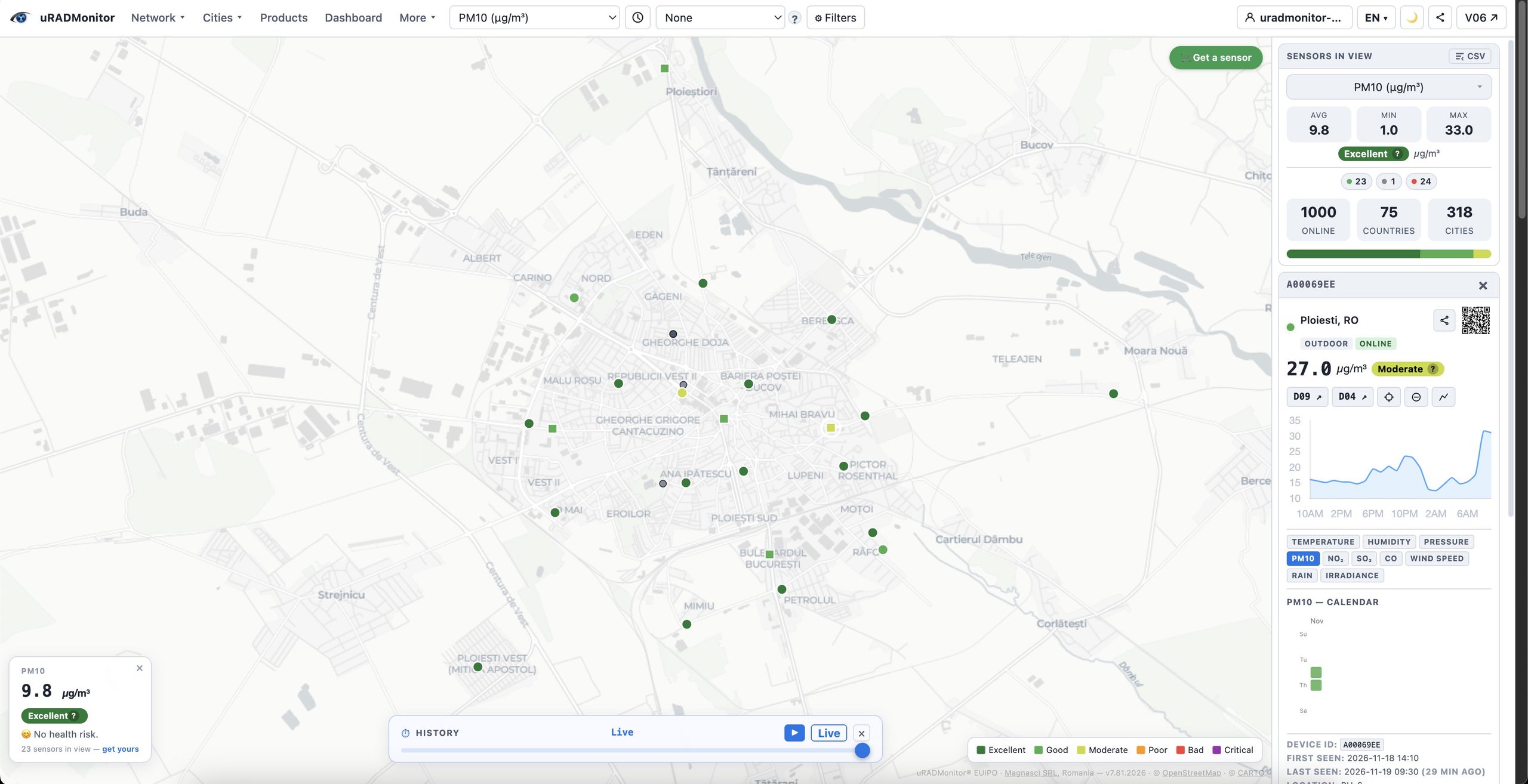
Reference networks are accurate but sparse, a national grid of tens to low hundreds of stations. Low-cost networks are dense but noisier. Combining them is strictly additive. In a city you now see both: the reference station anchors the true level, and the surrounding low-cost sensors fill in the spatial detail between official sites. The effective resolution in space and time is higher than either network reaches alone, without giving up the accuracy only reference instruments provide.
Intercomparison, in the open
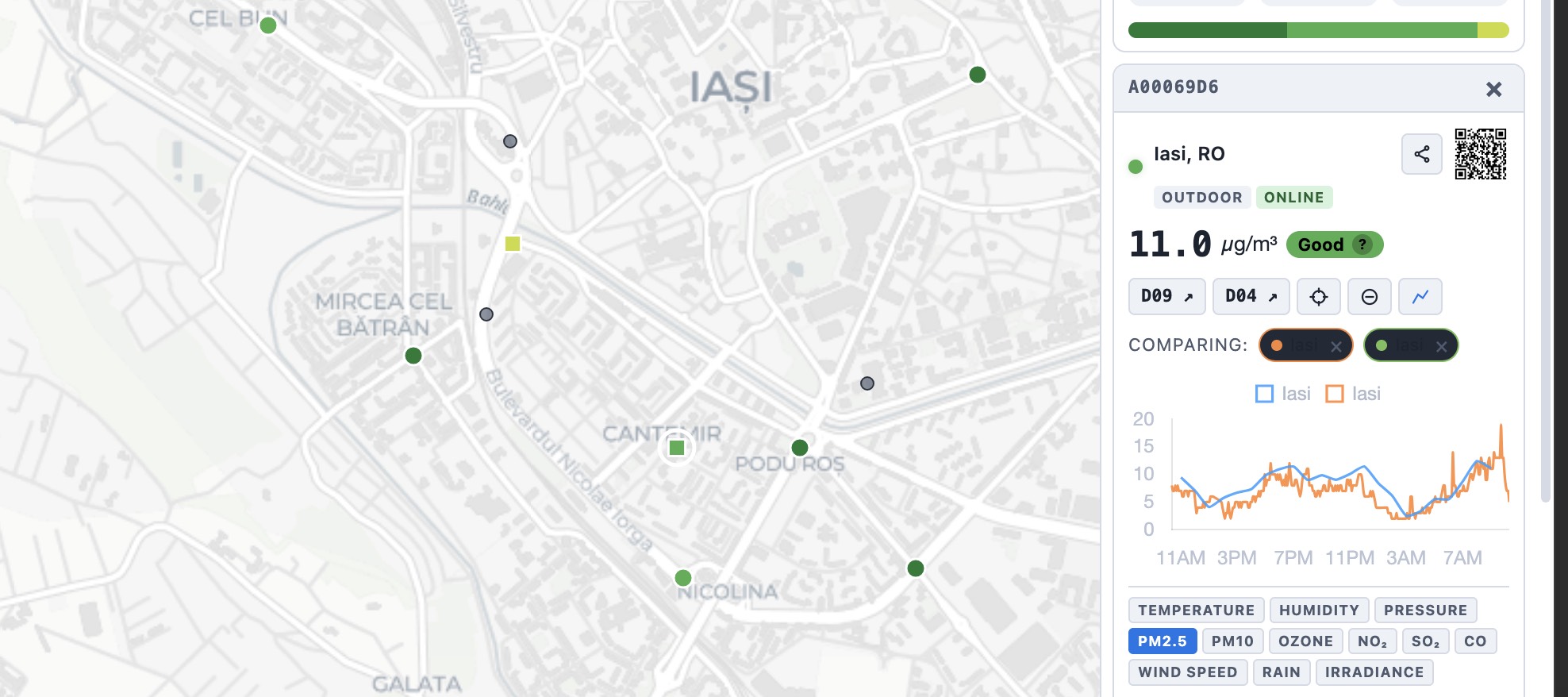
Because reference and low-cost readings now share one database, one set of units and one map, they can be compared directly, point by point and hour by hour. Where a low-cost sensor sits near a reference station, anyone can see how closely the two track. The network shows how it stands against the regulatory instrument beside it.
Real-time calibration from reference big data
With reference and low-cost data flowing together, every co-located pair becomes a live calibration signal. A low-cost sensor’s offset and drift can be estimated against the nearest reference station on an ongoing basis, and corrections applied in near real time rather than once, in a lab, at manufacture as it happened in the past. At network scale this is a big-data problem: many sensors, many reference anchors, continuous streams, and correction fields that move with weather and season. This is a gold mine for the research studies we will do next.
Characterizing the differences with AI
Low-cost sensors do not fail randomly. Their error is structured: particulate sensors read high in humidity, electrochemical gas cells respond to temperature and to cross-sensitivities, and aerosol composition shifts the response. These are exactly the patterns machine learning is built to capture. Trained on co-located reference and low-cost pairs, a model learns the transfer function between them, conditioned on temperature, humidity, pressure and the recent history of the signal. Applied back across the network, it corrects each low-cost sensor toward reference behaviour and, just as valuable, characterises where and why the two diverge.
How it works
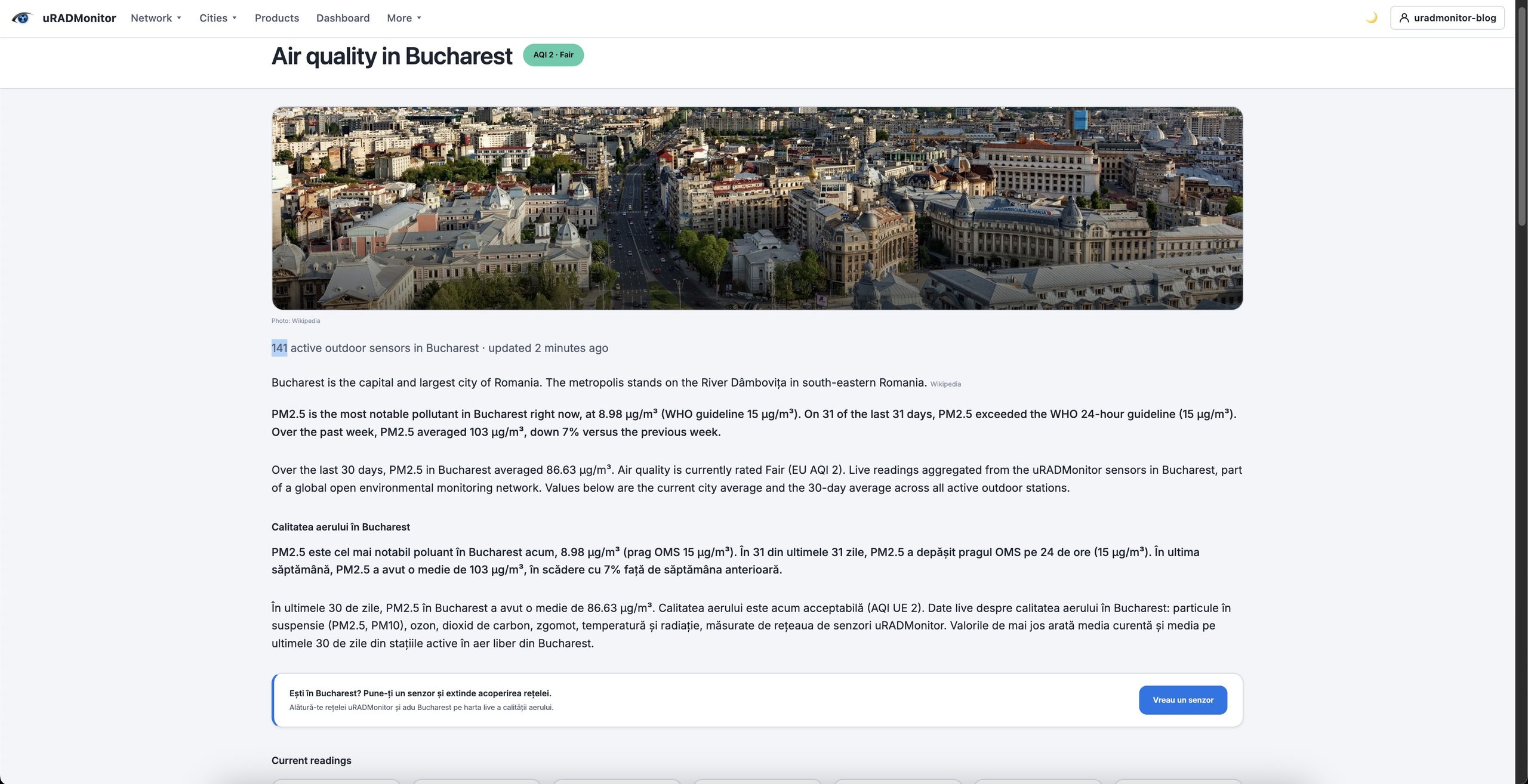
Each external network is modelled as a native uRADMonitor device model with real device IDs, so it flows through the existing infrastructure: map, API, history, export and city pages unchanged. On the map, official reference stations are drawn as squares, set apart from the circular low-cost sensors. Every reading keeps its source QA/QC state, raw, validated or certified, so data maturity stays visible. Gas concentrations are harmonized to mass units (µg/m³, CO in mg/m³) on the EU reference basis, so reference and low-cost values are directly comparable. Ingestion is continuous and idempotent, and station coordinates are reverse-geocoded to real city names so imported stations land on the correct city pages.
What comes next
RNMCA is the first external network we add and the potential it brings to uRADMonitor is huge. The same adapter pattern takes other national and regional networks, each as its own model, which opens cross-border comparability on one map and in one API. On the sensor side, the reference streams feed the calibration and characterization work above, moving the network toward per-sensor, continuously corrected readings.
Data and attribution
Reference data is sourced from RNMCA (Rețeaua Națională de Monitorizare a Calității Aerului, calitateaer.ro), Romania’s national network under the National Environmental Protection Agency (ANPM). Readings are shown with their published QA/QC state and are indicative alongside, not a replacement for, official regulatory reporting. uRADMonitor remains an open environmental network; combining community sensing with official reference data serves transparency on both sides.
Liked this? Get monthly air quality findings.
One email a month from the uRADMonitor network. Unsubscribe anytime.
codemore code
~~~~