The TechMP Webinar, July 15, 2026
uRADMonitor founder Radu Motișan was invited as a speaker in a live webinar organised by the University of Craiova, hosted by Prof. Ph.D. Mihaela Tinca Udriștioiu. The session brought together over 50 participants from Romania, Bulgaria, Greece, and North Macedonia, covering everything from the physics of ionising radiation to the practical engineering of a digital Geiger counter, with uRADMonitor as a real-world case study showing what a single sensor can grow into.
The presentation covered the basis: why radiation is invisible yet measurable, how a Geiger-Müller tube actually works, what a counter adds to a detector, and how combining the two with IoT connectivity turns a personal instrument into a node in a global monitoring network. Open-source code from the original uRADMonitor KIT1 was shown alongside live firmware excerpts, and the session ended with the observation that has defined uRADMonitor from the start: “not one sensor, but a network of many.”
The Project Behind It
The webinar was one activity within a larger Erasmus+ Cooperation Partnership in Higher Education, project code 2025-1-RO01-KA220-HED-000362472, titled “Improving Teaching, Learning and Research in Medical Physics in South-Eastern European Countries through the Use of Modern Technologies, Innovative Pedagogical Methods and Clinical Practice.”
The project runs from November 1, 2025 to October 31, 2028, with a total budget of €400,000. It brings together five institutions: the University of Craiova (coordinator), the University of Tetova, Paisiy Hilendarski University of Plovdiv, Aristotle University of Thessaloniki, and Papageorgiou General Hospital. Its target group covers 60 students and 12 teaching staff across the four partner universities.
The project develops clinical and theoretical competencies in medical physics, improves research and networking across partner institutions, and aims to make the discipline more interactive for students through workshops, webinars, shared teaching materials, and co-authored scientific papers. Among its planned outputs: four digital teaching modules, a laboratory guide, a collection of treatment plans, six virtual-reality videos, two scientific papers, and career maps for Romania, Bulgaria, North Macedonia, and Greece.
uRADMonitor KIT2: Built for the Classroom
Recurring involvement with physics students across multiple Erasmus+ events made one thing clear: a portable, battery-powered, self-contained Geiger counter that students can hold, understand, and programme themselves is a more effective teaching tool than any slide deck. That observation led directly to the development of the uRADMonitor KIT2.
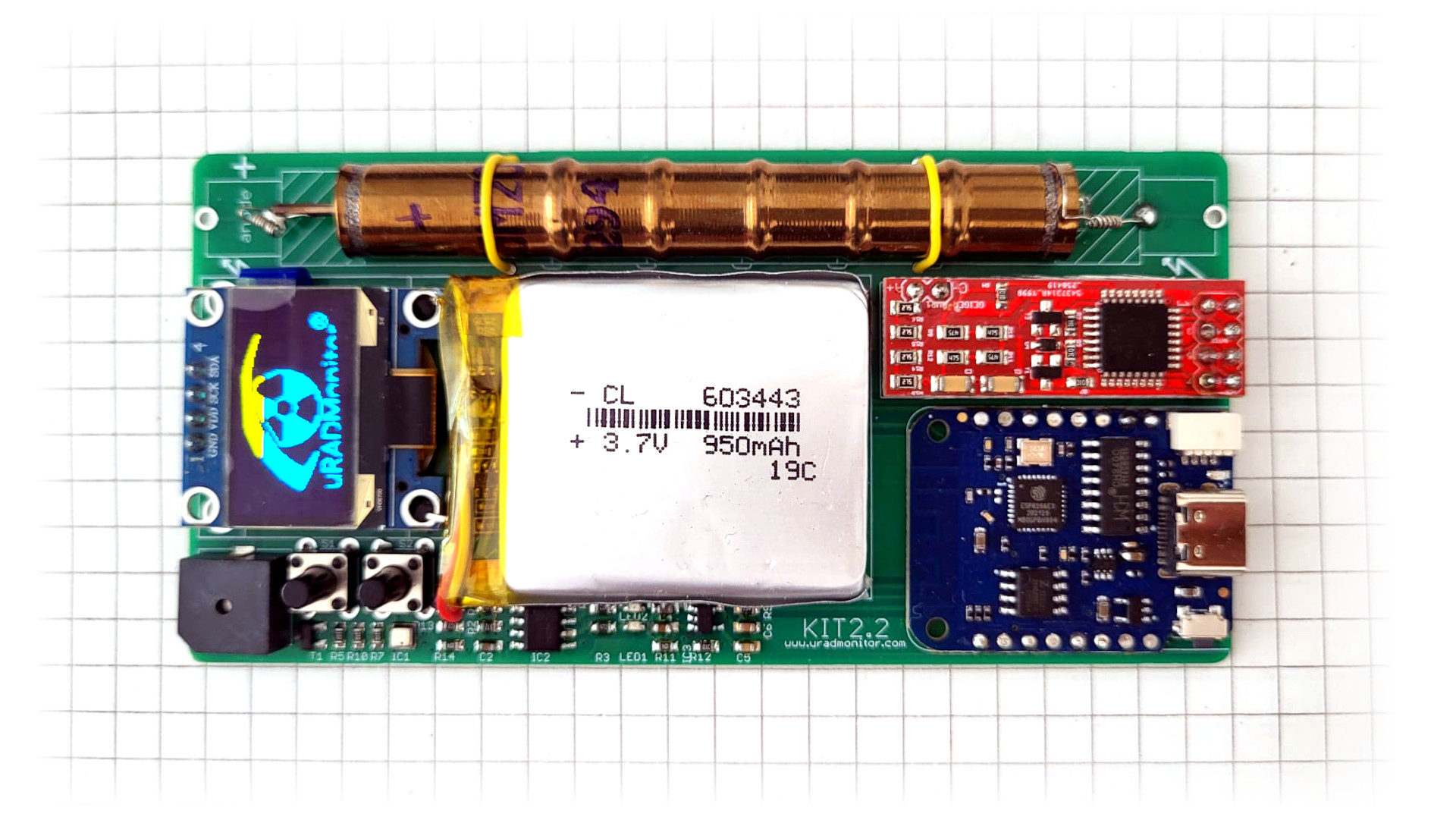
KIT2 is an open-source portable radiation dosimeter designed around simplicity, legibility, and real-world connectivity. The hardware centres on the proven uRADMonitor GeigerModule paired with an SBM20 Geiger-Müller tube, handling all the high-voltage supply and pulse detection. A Wemos D1 v4 board (with ESP8266) runs the firmware and provides WiFi connectivity for live data upload to the uRADMonitor network. The full spec:
- OLED display, 128×64 pixels, for live CPM and dose rate readout
- Two buttons for navigation and settings
- Soft-start, latch, and shutdown via long-press: no hard power switch needed
- Speaker for the characteristic click on each detected particle
- 950mAh LiPo battery, charged via TP4056
- Fully open-source firmware and hardware on GitHub
- 3D-printed enclosure, files included
The next student workshop is planned for early October 2026 in Craiova, as part of the same Erasmus+ project’s Medical Physics Summer School. Students will build their own KIT2 dosimeters, learning the underlying physics from the Geiger–Müller tube up. By the end of the workshop, each student will have a fully functional dosimeter connected to the global uRADMonitor network, contributing open data to this continuously expanding platform.
The KIT2 hardware files, firmware, and enclosure designs are available at github.com/radhoo.

codemore code
~~~~