
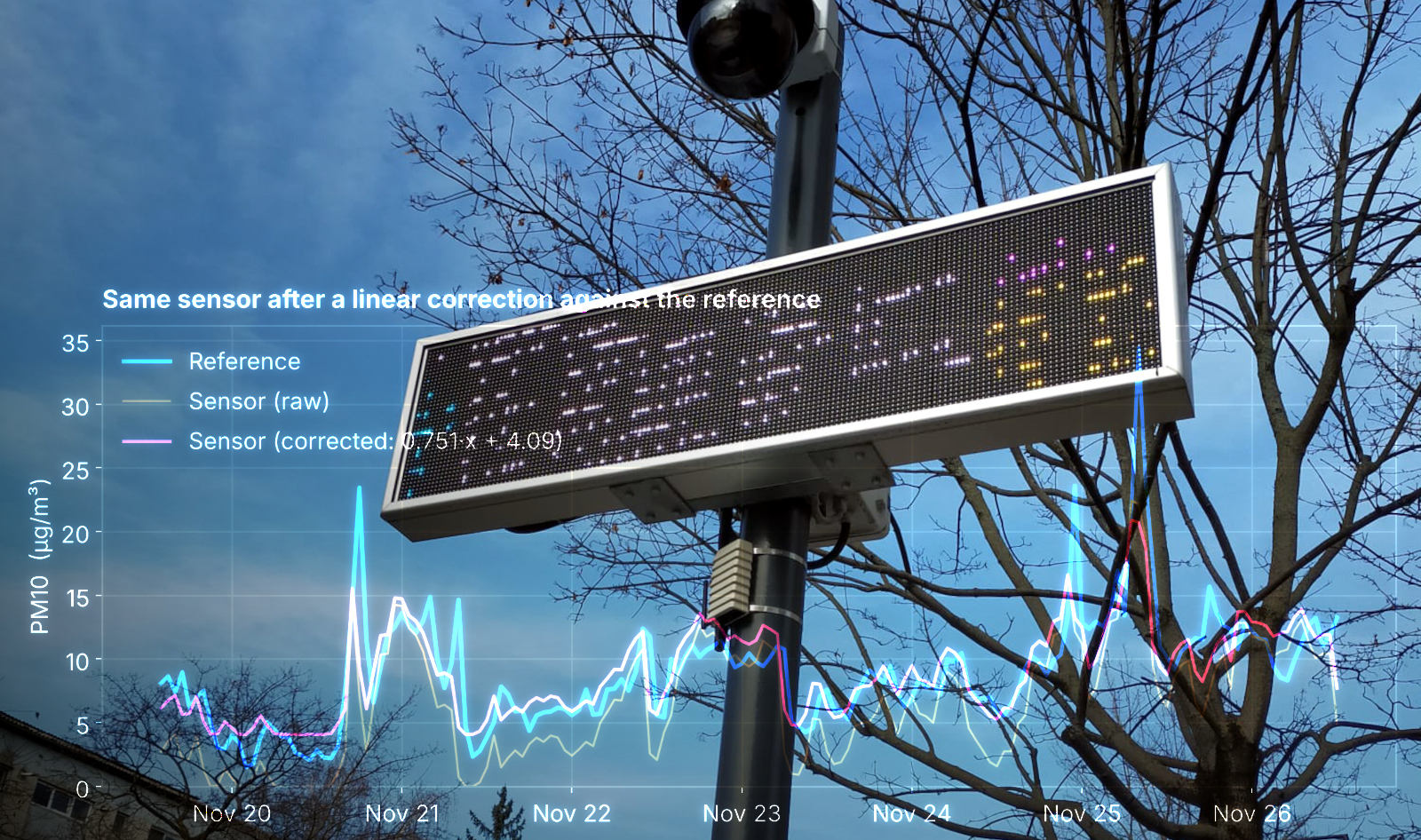
Directive (EU) 2024/2881 is the framework that will shape urban air quality monitoring across Europe for the rest of the decade. It was signed on 23 October 2024, published in the Official Journal on 20 November 2024, and entered into force on 10 December 2024. Member States must transpose it into national law by 11 December 2026, and it replaces the previous air quality directives (2004/107/EC and 2008/50/EC) from 12 December 2026. This guide summarises what the directive changes, what it expects from authorities, and where municipal and indicative monitoring networks fit.
The legislative timeline
| Date | Milestone |
|---|---|
| 23 October 2024 | Directive (EU) 2024/2881 adopted |
| 20 November 2024 | Published in the Official Journal |
| 10 December 2024 | Entry into force |
| 9 June 2026 | Implementing Decision (EU) 2026/1208 adopted (modelling and indicative measurements, spatial representativeness) |
| 11 December 2026 | Deadline for transposition into national law |
| 12 December 2026 | Previous directives (2004/107/EC, 2008/50/EC) replaced |
| 1 January 2030 | New limit values must be met |
What changes: stricter 2030 limit values
The 2030 annual limit values are an interim step toward aligning EU standards with WHO guidelines and the 2050 zero-pollution objective. For the pollutants with the highest documented health impact, the tightening is substantial.
| Pollutant (annual mean) | Current limit (µg/m³) | 2030 limit (µg/m³) | Change |
|---|---|---|---|
| PM2.5 | 25 | 10 | −60% |
| PM10 | 40 | 20 | −50% |
| NO₂ | 40 | 20 | −50% |
Lower limits mean exceedances that are invisible today will become visible against the 2030 thresholds. That raises the need for denser, better-characterised monitoring to locate problem areas, assess population exposure, and measure whether interventions actually work.
What authorities are expected to do
The directive places obligations on Member States, which act through their national and local authorities. In zones classified above the assessment thresholds, fixed (reference) measurements are used to assess air quality, and those fixed measurements may be supplemented by modelling applications or indicative measurements to describe the spatial distribution of pollutants and the spatial representativeness of the fixed stations.
Where limit or target values are exceeded, authorities must adopt air quality plans. Where monitoring between 2026 and 2029 shows a zone is not on track to meet the 2030 values, air quality roadmaps are required before the standards take effect. In practice, this pushes authorities toward more monitoring, not less, and toward networks that can resolve pollution at neighbourhood scale.
Where indicative monitoring fits
The directive defines indicative measurements as measurements that meet data quality objectives that are less strict than those required for fixed measurements. Critically, their results are not merely informational: under Article 8, the results of indicative measurements are taken into account when assessing air quality against the limit and target values.
Implementing Decision (EU) 2026/1208, adopted on 9 June 2026 and applicable from 30 June 2028, sets the technical rules for modelling applications, for determining the spatial representativeness of sampling points, and, in its Article 9, for the use of indicative measurements in air quality assessment. The direction of travel is clear: a well-characterised indicative network has a formal, recognised role in the European assessment methodology, not just a public-engagement one.
Counting comes with a condition: to be used in assessment, indicative measurements must meet the data quality objectives in Annex V, a maximum relative expanded uncertainty set per pollutant, demonstrated against a traceable reference rather than simply asserted. The exact uncertainty ceilings per pollutant, and how to verify a network against a reference station (R², slope and bias, RMSE and data capture, worked through on one real week of PM10 data), are covered in our companion guide: Technical Requirements for Municipal Air Quality Monitoring Networks under EU Directive 2024/2881.
What this means for your monitoring strategy
Three things follow for an authority planning a network under the new directive:
- Spatial density. Stricter limits and exposure assessment reward dense networks that resolve pollution street by street, which reference stations alone cannot do economically.
- Traceable data quality. Data that is continuously anchored to reference stations, with documented uncertainty, is data you can defend in an assessment or an audit.
- Performance-based procurement. Specifications should be written around the data quality objectives and verification methods above, and should explicitly accept equivalent solutions. A free, editable template is here: municipal air quality monitoring tender template (.docx).
How uRADMonitor supports municipal monitoring
uRADMonitor is not only a sensor manufacturer. The offer for a municipality has three layers:
- Infrastructure — independently evaluated instruments, installation and connectivity.
- Data Intelligence — reference-anchored auto-calibration, per-parameter quality classification, and statistical evaluation against national reference stations.
- Quality Assurance — continuous performance reporting, maintenance, and traceable calibration over the life of the network.
The instruments have a track record of independent performance evaluation, the data is integrated with national reference networks, and it is open and interoperable through a documented API and archive access. Municipal networks already run on this infrastructure in Cluj-Napoca, Bucharest, Timișoara, Brașov and Bistrița.
For transparency: we are a manufacturer and a potential supplier. The procurement template and the methodology above are written to be neutral and performance-based; an authority adapts them through its own legal service, and no specification is conditioned on our products.
Related reading
- Technical Requirements for Municipal Air Quality Monitoring Networks under EU Directive 2024/2881, how to verify a network meets the data quality objectives.
- What Municipal Air Quality Monitoring Costs Under EU Directive 2024/2881, reference stations versus sensor networks, and how to budget.
Sources
Liked this? Get monthly air quality findings.
One email a month from the uRADMonitor network. Unsubscribe anytime.

codemore code
~~~~