
- This topic has 4 replies, 3 voices, and was last updated 6 years, 1 month ago by
.
Viewing 5 posts - 1 through 5 (of 5 total)
Viewing 5 posts - 1 through 5 (of 5 total)
- You must be logged in to reply to this topic.
Paul Probett. Stratos Zolotas
Hello,
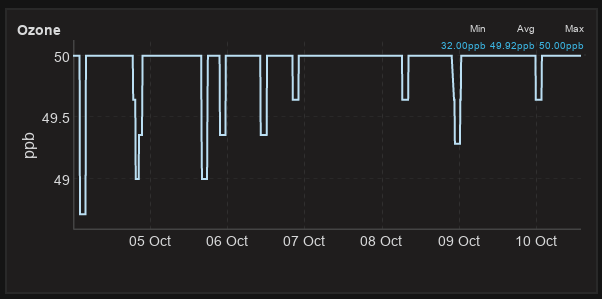
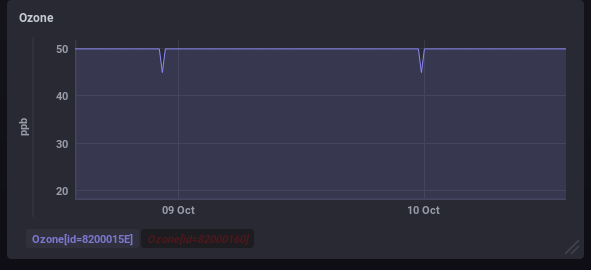
I don’t get why the ozone readings are flat on 50 ppb most of the time with only some down-spikes appearing from time to time. The API data are also the same as it seems from the additional graph.
Am I missing something? Sensor is HW:106 SW:137 id:8200015E.
I had post this again but on a general thread so maybe it didn’t get any attention.
Thanks.
 uRADMonitor
Hello @Baskin, I raised this question with the manufacturer of the Ozone sensor. After passing them all relevant info, I finally receive their input:
As checked with our engineers, it seems that the ambient air does not have too much O3 concentration.
If actual ozone concentration is very small, then ZE25-O3 may have output value for 20ppb or 50ppb.
The value will increase as ozone concentration increases.BTW, you can breathe a breath at the sensor, and check whether ZE25-O3 value will change or not.
Thanks
Radu
Stratos ZolotasOk that seems clear enough and logical explanation. I’ll try to check with breathing because it is installed outdoor and not easy to breath on it, haha! I’ll update if I have any issue. Thank you very much.
uRADMonitorI continued the discussions with the sensor manufacturer. Here are some additional details:
If the ambient ozone gas concentration is less than 200ppb then the sensors will have no value change.
That is what we get when we see constant values that are just being repeated, usually the 50ppb line.
its detection range is 200ppb–10ppm normally
What this means is we cannot see the fine fluctuations in normal environmental conditions, instead the sensor will react to higher values only.
if the ozone concentration is less than 200ppb the sensor cannot read it
 Paul Probett
Hi there,
Just wondering. In New Zealand, our workplace standards have a Ceiling Limit of 0.1ppm (100ppb) for Ozone. Both NIOSH and OSHA in the USA also have limits of 0.1ppm for Ozone.
Does this mean that the sensors used in the A3 are not really of much use for detecting compliance with these standards due to the detection range being 200ppb-10ppm, unless the Ozone is over 200ppb?