Home › Forum › Hardware › Model D feedback › Reply To: Model D feedback
 uRADMonitor
A few important things you should all now:
1.Many reported the PCB moves inside the enclosure. This should have not happened, but the manufacturer left out some self adhesive tape that should have been installed on the inside, at the end with the LND712 tube (that requires extra care). Picture with the foam attached below. Please install such stoppers yourself, the board is 1mm shorter than the enclosure. Alternatively, you can force the tips of wood toothpicks between the PCB and the aluminium rails, cutting the extra.
2.The clicking sounds are for the Geiger Counter. They indicate a radiation pulse has been recorded. You can mute them in Settings
3. The LCD is “unstable” or “works intermittently”. The screen can either work or not work at all, but for the clicks on screen, please keep what you want to click, pressed a little longer. No need to force the screen, it is very sensitive and fragile.
The problem is the CPU is a bit low with all the many features added to the design. So sometimes , it is unable to process clicks as fast as we’d like. Once you connect to Wifi it will run smoother. Failing to connect burns CPU cycles.
Also the LCD uses a resistive touchscreen, not the capacitive one you’re used with from your mobile phones. The resistive ones require precise focused taps (using a stylus or the nail).
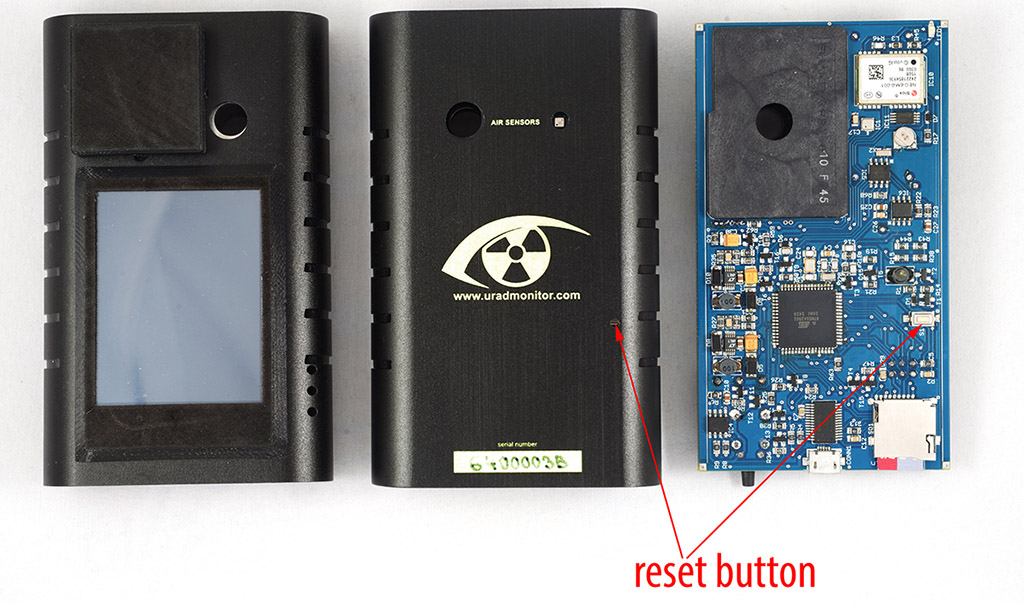
4. The reset button. It can be located using the picture attached. Use it if there are any issues with the unit.
5. Screen turning off. There is a 30seconds timeout to the LCD screen to save power. Tap the screen to turn it back on.
6. Battery normal voltage. The units have an internal Lithium Ion battery, and while the nominal voltage is 3.7V, the normal discharge path goes from 4.2V (more or less when fully charged), to about 3.2V. The uRADMonitor unit will turn off automatically when the voltage is below 3.4V, because there is a real time clock that needs the extra power.
7. VOC readings. The VOC numbers are not comparable from one sensor to another. There is no UM for VOC, and the manufacturers have different approaches on what they consider VOC. Normally the technology implies a sensor with an embedded burning filament (300*C) that consumes various gases from the air (both Oxidising and Reducing reactions), and as a result, the electric resistance changes.
On your D units, you see this electric resistance, in Ohms, fluctuating to air quality. Bosch did a great job with the BME680, as stability is a big issue on this approach and not many sensors are up for the job (tested many). A clean air is when the resistance is higher: no burned products contributting to conductivity across the sensor crystal. On the other hand, for polluted air we’ll see lower ohmic value. The quantities of detectable gases is listed on: http://www.uradmonitor.com/uradmonitor-model-d/
Now the good news is Bosch provided us a post processing BME680 software library that we are working to integrate on the server. Then, accessing your unit’s data from the server via the API (see http://www.uradmonitor.com/dashboard) , will give you the processed VOC readings as an air quality score index.
This library also does auto-calibrations to temperature and humidity data, that can be affected by the enclosure and the extra heating from the other components (battery, charger, wifi module, microcontroller).
(I’ll add more when needed)